
Diary of a Shopkeeper, 10th May
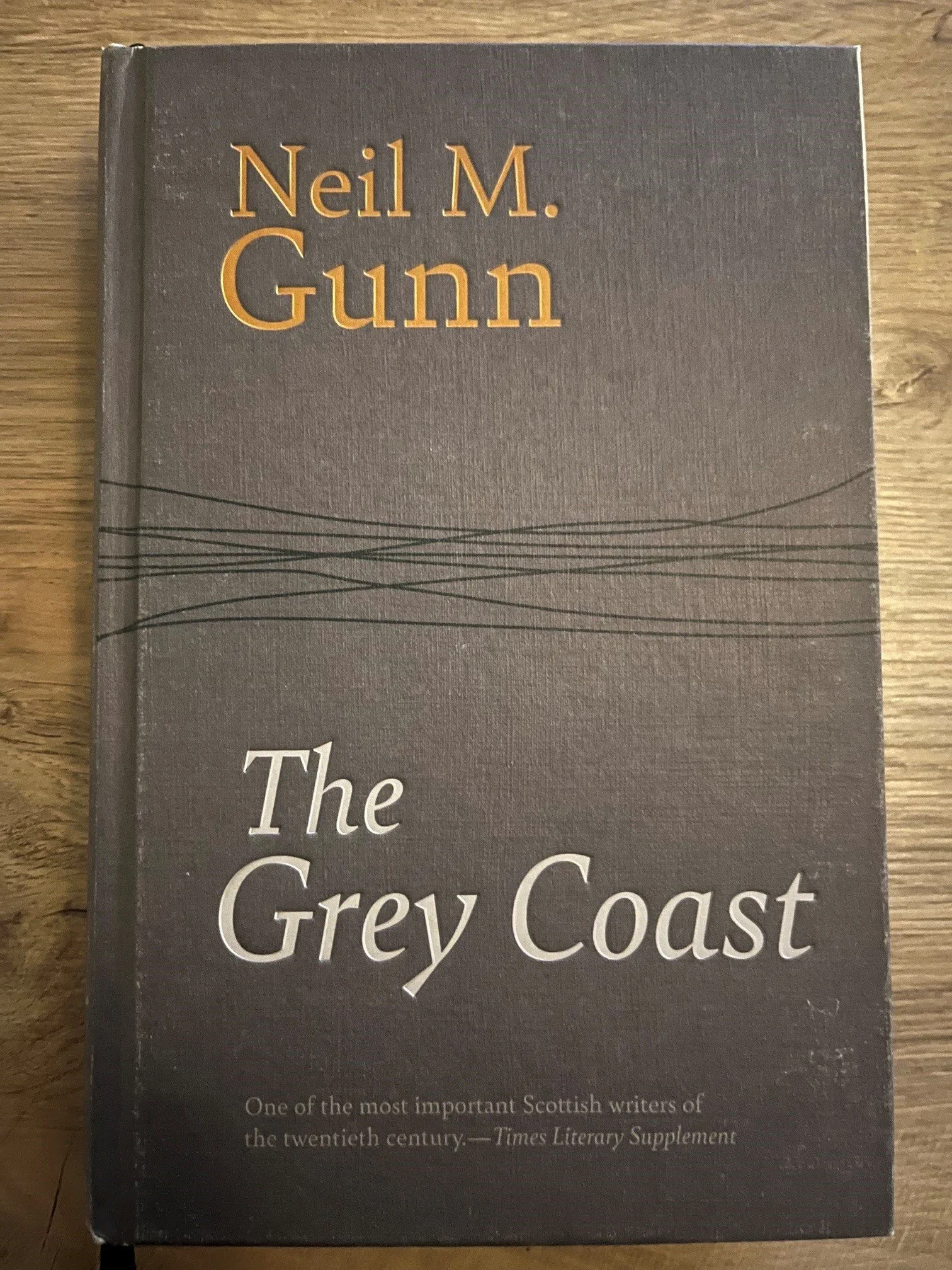
And of all places, such a grey strip of crofting coast…was surely the place for the perfect growth of this duality of the mind, whereby the colourless, normal life becomes at once a record of the stolidly obvious and of the dream-like unknown.
Neil Gunn, The Grey Coast (p22 - 23)
. . .
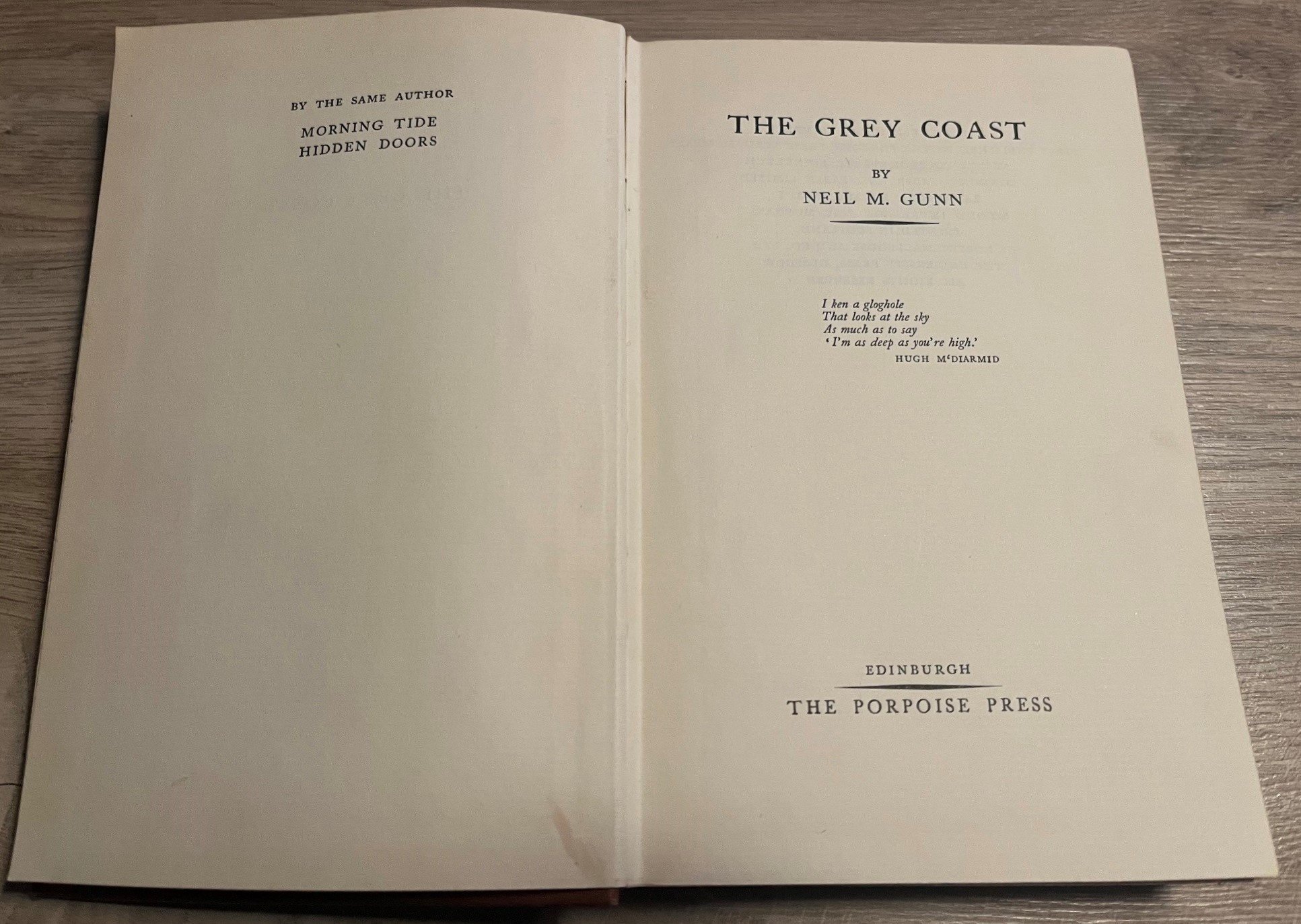
The Grey Coast by Neil Gunn was published in 1926 by leading London imprint, Jonathan Cape. Now a new venture, North House Press of Dalreavoch, Sutherland, has republished it and two later Gunn novels in handsome hardbacks.
Gunn was born in Dunbeath, Caithness, in 1891, one of nine children. The Gunns were a fishing and crofting family, but Neil’s mother was determined he should not follow his father into the dangerous and declining fishing industry. As a teenager, Neil was sent first to a relative in Galloway, and then to London, and finally Edinburgh. He worked as a civil servant and in 1921 married Daisy, the daughter of a jeweller from Dingwall. After various postings they settled in Inverness, where he was attached to Glen Mhor distillery as an excise officer. He divided his time between whisky oversight in the mornings and writing in the afternoons.
His first novel came relatively late, when he was 35. It was worth waiting for: The Grey Coast was published by the best literary house of its day and was a critical if not a commercial success. So how does it read one hundred years on?
The first thing that’s striking is that, despite the book’s title, there is little of the open spaces of the Caithness coastline and moorland. It’s largely a domestic story, with a small cast: Jeems, an elderly, miserly crofter; Maggie, his orphaned niece who works as his housekeeper; Tullach, a successful farmer looking for a wife to top-off his social status; and Ivor, a young fisherman, looking for escape from the restricted life he’s trapped in. That could also involve wooing Maggie, if only he could find the words to suggest it to her. If only he could find the words to say anything at all!
The drama is claustrophobic. Much of it takes places in the kitchen of Jeems’s croft, where the temperature of his porridge can stir up profound passions. Maggie’s escape is to the byre to milk the cow, or fetching peats to feed the smouldering fire at the heart of the home. Smouldering could be the central metaphor for the characters’ actions. Jeems is smouldering with fear of death, but he can’t express the emotion: ‘Couldn’t he say what had to be said, and be done with it?’ Maggie thinks. She’s not much better at expressing herself, neither regarding the overbearing attentions of the brutish Tullach, nor the more welcome but bumbling approach of young Ivor.
There’s a long and sensible tradition in close-knit rural communities of people not giving strident voice to their views and feelings. Communication is often based on implication and subtle non-verbal cues rather than declarations of love or anger. So in terms of linguistic accuracy, Gunn’s approach is highly realistic. But in terms of storytelling, it leaves the reader feeling that the characters are less relatable – whether in a good or bad way – than satisfying narrative requires. Even Maggie, who, in most chapters, provides the point of view and the emotional heart of the book, does little more than agree with whatever the previous speaker has said to her. In 300 pages she says no more than a few score words.
Rather than revealing character through dialogue, Gunn prefers to analyse thought and feeling in convoluted purple prose. I don’t want to waste my few short paragraphs here by quoting it at length, but it’s the biggest shortcoming of the novel. It’s a shame, because when Gunn does portray action and allow his characters to talk, he creates passages of real excitement and resonance. It’s as if he doesn’t trust himself to tell a story, or trust his characters to live their lives on the page. He has to keep intervening with stuff like this, while Maggie is feeding the hens: ‘Empty unreality of life, of grey morning; immaterial husks drained of all pulse-beats through mornings to come to the end of time.’
Interestingly, when a second edition of the novel was published in 1931, Gunn made hundreds of changes. These weren’t major alterations of character or incident, but small cuts to some of the verbiage. In the original, for instance, Jeems struggles to fall into restful sleep, ‘Till thought found the unfathomed ways of oblivion.’ In 1931, that becomes, ‘Till thought found oblivion.’ It’s fitting for this centenary edition of the book to reproduce the text of the original 1926 text, but I believe the 1931 version reads better.
If I seem critical of Gunn’s narrative style, it’s partly because the work of one of his contemporaries kept springing to mind as I read the novel. It’s documented that Lewis Grassic Gibbon read and enjoyed several of Gunn’s books. More than that, it’s clear that The Grey Coast was a considerable influence on Sunset Song, which came out six years later. There are many similarities between Maggie and Chris Guthrie, and in the depiction of farming life in turn-of-the-century Scotland. There are even specific scenes that Gibbon – consciously or unconsciously – wrote his own versions of. For instance, in Chapter 17 Maggie gazes in a mirror, her appraisal of her physical appearance revealing much about her view of her own character. Gibbon has Chris do exactly the same thing in the ‘Drilling’ chapter of Sunset Song – though with more insight and lyricism.
There’s no shame in writing a lesser novel than Sunset Song, which is frequently rated as this country’s greatest. The Grey Coast is essential reading for students of Scottish literature, or anyone interested in the history of the Highlands. But Gunn’s own reputation as an important novelist rests on works produced later in his career. I’ll be coming to two of those in the weeks ahead.
You can read more about North House Press here, and buy all three Gunn reprints at a special reduced price: great value, for three beautifully produced hardbacks.
This diary appeared in The Orcadian on 14th May 2026.. A new diary appears weekly. I post them in this blog a few days after each newspaper appearance, with added illustrations, and occasional small corrections or additions.