
Cheese
With a hunk of bread or a salad, cheese can be a meal in itself. Or, carefully cut and presented, it makes a grand finish to a special dinner. And it’s an essential ingredient in a thousand delicious recipes.
Whatever your favourite, and whatever you’re going to do with it, we have the cheese for you…
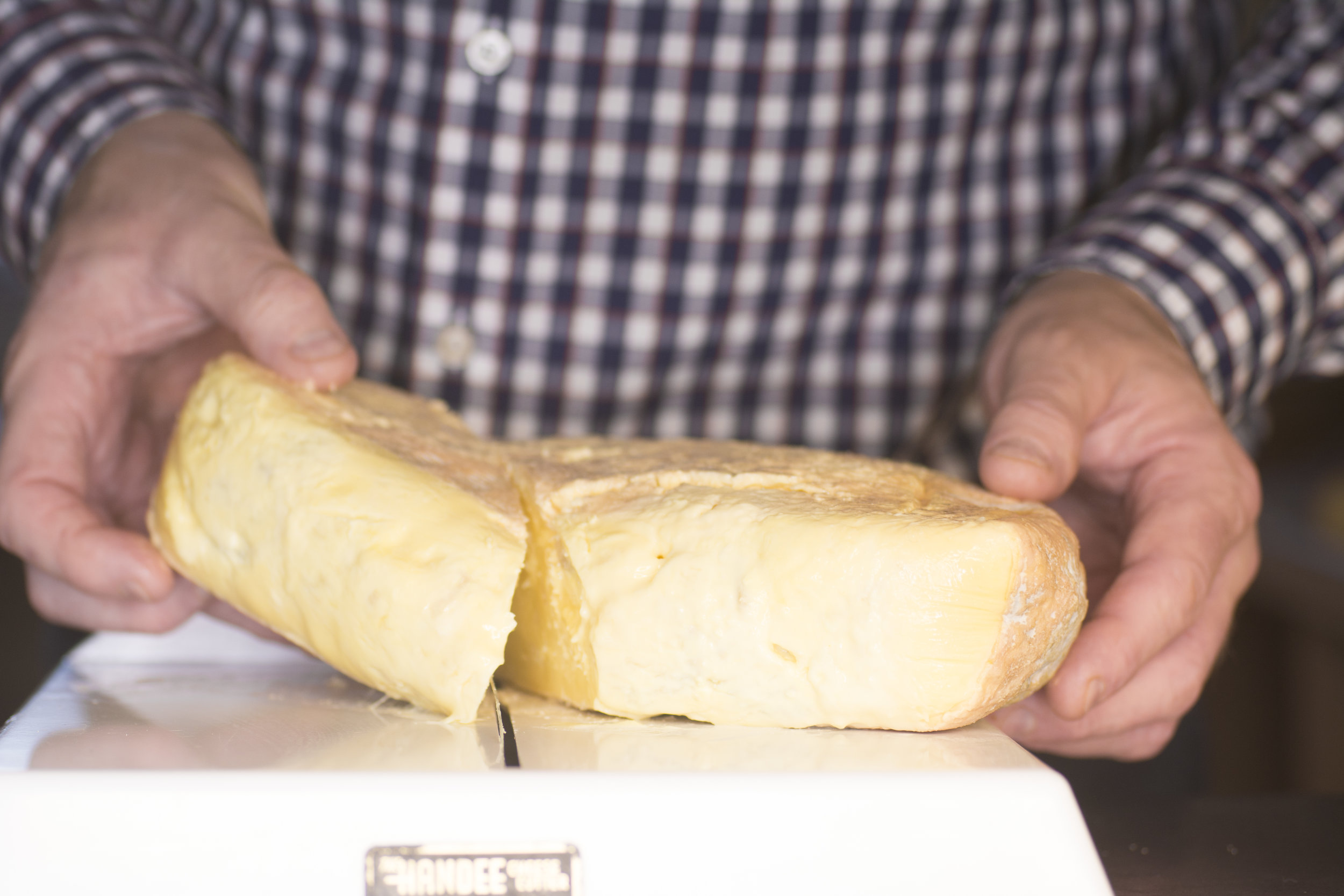

Our cheese selection
We always have at least 60 cheeses in our fridge. New deliveries arrive once or twice a week – more often at busy times – meaning that our selection, as well as being large, is always in perfect condition.
We have a core range of about 30 cheeses that are always in stock. In addition, we buy in about 70 other cheeses on a rotating basis, so that everyone’s favourite, no matter how obscure, will make an appearance in our fridge every three or four weeks.
All our cheeses are labelled to make it clear which milk they are made from, whether they are pasteurised or raw, whether they’re vegetarian, and their organic status. Best of all, just ask us for more information – or for a taste!
Orkney
Cheese has been made in Orkney for centuries, but there are only a few commercially-available cheeses these days. All are made with cow’s milk.
Grimbister is a mild, pure-white farm cheese, and a real summer favourite. Orkney Cheddar is firm, close-textured and available in a variety of maturities. We usually stock the Extra Mature version, as we feel it has most flavour. The Orkney Smokery produces various strengths of smoked cheddar and we usually have one or two available: great bubbling on toast or in macaroni cheese!
Wilsons of Westray have now retured from cheesemaking. Luckily for us, they passed their recipes on to Barry from Burnside Cheese, who as well as his own excellent Burnside farm cheese, also makes Norseman (using the Wilsons’ Noltland Castle recipe) and Cannonball (hung in a cloth to firm up in texture a little, with the flavour becoming a touch stronger too.)
Going back to Burnside for a moment, Barry suggests it would be a good alternative to paneer or halloumi, and it has become a popular choose on restaurant menus in whipped form. Delicious!
Orkney butter varies in availability, but we get it when we can: it’s bright yellow in colour, and lightly salted.
At the moment, despite many customer requests, there are no Orkney cheeses made from goat or sheep’s milk. Nor are there blue or soft Brie-style Orkney cheeses. That’s where the rest of the world comes in…
Scotland
In our opinion, what Scotland does best is hard cheeses. Some of our best-loved cheddars are Isle of Mull, Loch Arthur and St Andrews.
There are some good sheep and goats cheese. A tegular in our fridge in Inverloch hard goat’s cheese from the Mull of Kintyre (mist rolling in from the sea.)
The Highland Fine Cheese Company is based in Tain, just down the A9. Run by the Stone family, they’re notable for producing a wide range of styles, from Gruth Dhu (‘black crowdie’) to Strathdon Blue to Highland Brie. All are excellent. And a special shout out to Minger, Scotland’s answer and Stinking Bishop!
Scottish cheese is evolving quickly, as more and more artisan makers reconnect with old traditions, and dream up exciting new variations.
England, Wales, Ireland
England gives us fantastic cheddars like Westcombe, and Godminster Organic Cheddar. Other great hard cheeses include Sparkenhoe Red Leicester and Single or Double Gloucester, as well as ‘territorials’ like Kirkham’s Lancashire, Appleby’s Cheshire and Hawes’ Wensleydale.
Semi-hard favourites include Cornish Yarg and Sharpham Rustic, which is reminiscent of an old-style mature Orkney farmhouse cheese.
There are several English soft cheeses now that can be considered the equals of great French soft cheeses. Tunworth, for instance, has been described as ‘The best Camembert in the world,’ by none other than Raymond Blanc. Baron Bigod is another favourite. And Stinking Bishop is an outstandingly smelly washed-rind cheese to rival Epoisses.
As for blues, Stilton is probably the first name that comes to mind, and every winter we sell large quantities of fine examples, with Colston Bassett being our first choice. Shropshire Blue and Yorkshire Blue are two other fine examples.
From Wales we get Thelma’sCaerphilly, Perl Wen (Brie-style) and Perl Las (a mild blue) and another of our best sellers, Black Bomber, from the Snowdonia Cheese Company.
Ireland gives us occasional visitors Knockanore and Gubbeen, as well as one of our best selling blues, creamy Cashel Blue.
France
We’re great believers in shopping local, and in eating local produce. But we must be honest: sometimes certain parts of the world have achieved perfection in making a foodstuff that other countries can only dream of equalling.
Look, we’ll just come out and say it: we think France makes the best cheese in the world.
To be exact, we think that France regularly produces more great cheeses, in a greater variety of styles, than any other country. Scotland, England, Italy, Spain… all of these countries have distinctive local cheeses that equal the best of France; but France excels in ALL styles. I mean, consider the following, a typical selection that we might have over any two or three weeks…
Soft
Brie de Nangis
Brie de Meaux
Brillat Savarin
Morbier
Camembert Petit Normand
Chaource
Vacherousse
Vacherin Mont d’Or (October to March only)
Neufchatel
St Marcellin
Blue
Papillon Organic Roquefort
Bleu de Causses
Bleu d’Auvergne
Fourme d’Ambert
Washed Rind
Epoisses
Trou de Cru
Munster
Maroilles
Langres
Hard and Semi-Hard
Cantal au Lait de Salers
Comté
Beaufort
Abondance
Tomme de Savoie
Raclette
Goat’s and Sheep’s
Banon
Cabécou
Selles sur Cher
Crottin de Chavignol
Ossau Iraty
Valençay
Other countries
Our most popular Spanish cheese is Manchego, but other favourites include Monte Enebro, a prize-winning soft goat’s cheese, and Picos Blue, which is a crumbly, very strong blue, wrapped in maple leaves.
We always have one or two Gouda-style cheeses from the Netherlands. We prefer well-aged versions, such as Beemster XO, which has a lovely butterscotch flavour and crunchy crystals. Prima Donna is another perennial favourite. Gouda with Cumin Seeds was a popular addition in 2025.
From Germany we have Montagnolo Affine, a mild, buttery blue that was Supreme Champion at the 2013 International Cheese Awards. It’s a great introduction to blue cheese for anyone who hasn’t tried it before.
Switzerland gives us some excellent hard mountain cheeses, including Gruyère and Etivaz.
From time to time we bring home a special selection of Scandinavian cheese, but one we have week in week out is Gjetost from Gudbrandsdalen. This is one of the famous Norwegian brunosts – ‘brown cheeses’ – a dense, sweet, fudgey cheese.
Italy produces a lot of good cheese, and some great cheese. Parmigiano is the ultimate grating cheese, but it’s great to nibble on too. Gorgonzola is one of the world’s finest blues; we love the Dolce version, sweet and creamy. Taleggio is an excellent and fairly pongy washed-rind cheese. We get various Pecorinos in throughout the year, including mature Nero; Rosso, its rind brushed in tomato pulp, and young and soft Dolce. Our most popular variety is Pecorino Tartufo, which is semi-hard and speckled with black flecks of truffle. Its aroma is heavenly.
. . .
Because of the time it takes to mail these perishable items out of Orkney, we don’t usually sell cheese on a mail-order basis. However, if you think we have the unique solution to your cheese requirements, get in touch and we’ll help if we possibly can.
Check out our blog for news on our latest arrivals, recipe ideas, and special cheese tastings.