
Diary of a Shopkeeper, 18th January
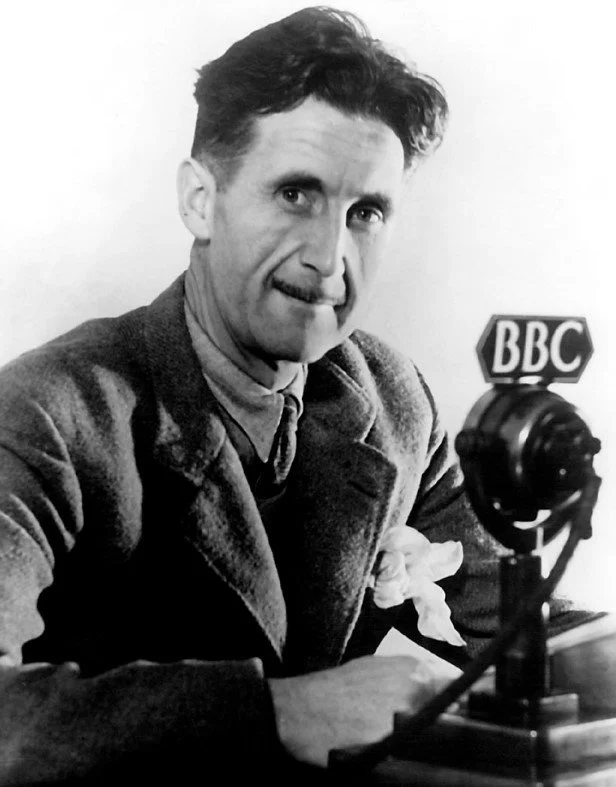
George Orwell, considering his words.
The writer Christine Brooke-Rose served at the famous code-breaking centre of Bletchley Park during World War II. It was here that Alan Turing and his colleagues unlocked the Enigma cypher, thereby, it’s suggested, shortening the war by two years and saving thousands of lives. Brooke-Rose grew up in Geneva and Brussels, moving to England when her parents’ marriage ended. Shortly after joining the WAAF as a clerk aged 18, her multilingualism was noted and she was posted to Bletchley Park. She remained there for the duration of the war, a key part of the team that deciphered encrypted German communications.
Years later, when she became a novelist, she loved playing games and setting puzzles. Sometimes she created challenges for herself, like writing an entire novel without the verb ‘to be.’ In Between (1968), there is never a sentence like ‘I am’, ‘she was’ or ‘they are.’ Initially the reader is likely to feel there’s something odd about the book, without being able to put a finger on exactly what. Eventually, when realisation dawns, the effect is deeply unsettling.
Why did Brooke-Rose take this approach? From a literary point of view, it was to remove the possibility of anyone – characters or reader – being able to complacently ‘be’ anywhere with certainty. Everyone – the characters in motion, the reader in understanding – is always on the move. I am sitting at the kitchen table as I write this, but if I wasn’t able to use ‘am’ I’d have to write something like, ‘Hunched at the kitchen table, thinking and typing, I write this week’s Diary…’ It’s full of fluidity: nothing is fixed.
From a psychological point of view, why did Christine Brooke-Rose choose to impose this restriction on herself? In her strange autobiographical text, Remake – strange because it’s written without the word ‘I’ – she remembers her time at Bletchley Park: ‘Knowledge came out of the air,’ she says, ‘intercepted, decrypted, translated, transmitted.’ Meaning had to be identified and rescued, ‘from an ocean of fuzzy noise.’ The novels she wrote decades after her wartime experience also had meaning buried deep within, but the reader has to do a lot of intercepting, decrypting, and translating before beginning to grasp it.
All of this popped into my head the other day while out in the van doing a delivery. On the radio, there was discussion of the US raid on Venezuela. What struck me was that both the people who thought such action was justified and those who thought it outrageous used the same word – ‘extracted’ – to refer to what the US forces had done to President Maduro. Later, reading more online, I came across the same word in many reports, not least in a statement attributed to the chairman of the US Joint Chiefs of Staff, General Caine:
The mission to extract the Maduros […] was so precise that it involved more than 150 military aircraft from all across the Western Hemisphere launching in close coordination to provide cover for the ground-based extraction force in Caracas.
When I hear the word ‘extract’ my mind goes to something like pulling a cork from a bottle, or poking a pip from a lemon wedge. It isn’t usually something that involves 150 military aircraft. But this new meaning was suddenly everywhere, with politicians and journalists speaking as if the word had never meant anything else than sending hundreds of troops into a foreign country to capture a dictator and his wife.
As George Orwell pointed out, politicians find it useful to describe their actions in words that hide more than they reveal: ‘Defenceless villages are bombarded from the air, the inhabitants driven out into the countryside, the cattle machine-gunned...this is called pacification.’ ‘Such phraseology is needed,’ Orwell said, ‘if one wants to name things without calling up mental pictures of them.’
Hence ‘extraction.’ Something that involved hundreds of planes and dozens of ships, bombing of at least five Venezuelan locations, and the violent deaths of, it’s estimated, 50 military personnel and 30 civilians, is pictured as nothing more dramatic than popping a stone out of an olive. Politically active friends might think this a rather dilletante point: should I not be speaking out about the rights and wrongs of the politicians’ actions rather than quibbling about the words they use and abuse? I’m with Orwell: words are important. I thought this again when listening recently to the speech Robert Jenrick made on leaving the Conservatives for Reform:
I challenge anyone to argue Britain is not completely broken,’ he said, ‘At a recent Shadow Cabinet, a debate broke out. The question was put to the group, ‘Is Britain broken?’ I said, ‘It's broken.’ Almost all said, ‘It's not broken.’ And we were told that's the party line.
What meaning can we intercept, decrypt, and translate from the ocean of fuzzy noise surrounding this news story? What I get is that ‘Broken Britain’ is a useful phrase for politicians to sling about. It’s catchy, and punchy, but, as Orwell might say, hides more than it reveals. I find myself in the unexpected position of agreeing with ‘almost all’ of the Shadow Cabinet. Britain isn’t broken. It’s working extremely well – just not for all its people. It’s working brilliantly for that Shadow Cabinet, and for investment bankers, bond traders, speculative property developers, and millionaires generally.
To say, ‘Britain is broken’ is as duplicitous as saying ‘Maduro was extracted.’ I’d like to thank Christine Brooke-Rose, a mere novelist, but one who spent years helping defeat fascism, for helping me break this code.
This diary appeared in The Orcadian on 22nd January 2026. A new diary appears weekly. I post them in this blog a few days after each newspaper appearance, with added illustrations, and occasional small corrections or additions.