
Diary of a Shopkeeper. 1st November
I sneaked out of the shop on Friday afternoon to see the temporary exhibition at the Orkney Museum, Aglooka: John Rae, Indigenous Knowledge and the Arctic. If John Rae could walk tens of thousands of miles across the far north, you’d think it would be easy for me to walk the length of Broad Street. But over the busy months of summer, it can be hard to find even half an hour off, and I’m constantly rushing along to see shows just before they close.
Such was the case with Aglooka. It ran for four weeks, from 3rd to 31st October, and I wish I’d seen it earlier so I could have returned a couple of times to explore it further. I also wish I could have recommended it to readers of this column when they still had a chance of visiting. It was a truly fascinating exhibition.
The outline of John Rae’s life is well known to every Orcadian: born in 1813 and raised in Clestrain, the grand house which marks the Stenness-Orphir border. Trained as doctor, he headed off to Canada at the age of 19 and spent the next 50 years exploring various parts of the far north, inbetween spells spent in Britain recuperating or fundraising for future trips.
These days a lot of our admiration for Rae is based on how he respected and learned from the indigenous populations of the nor-wast. The Hudson’s Bay Company itself was a ruthless exploiter of the resources and people of a vast area – equivalent to 40% of modern-day Canada. Its rapaciousness was exceeded only by that of its contemporary on the other side of the world, the East India Company. While employed by the Company for many years, Rae’s approach differed from many other Europeans in Canada. As the museum puts it, “Rather than imposing European methods on an unfamiliar landscape, he learned directly from the Inuit and other indigenous peoples whose ancestors had lived in the Arctic for countless generations. Rae adopted their techniques of travel, clothing, shelter building and hunting, recognising that survival in the North depended upon local knowledge and experience.” A side room is directly connected to Rae, with artefacts from Clestrain, as well as tributes to Rae by Orkney artists including Jane Glue, Andrew Appleby and Joan Holdswoeth.
On the walls of the main room are art works by contemporary indigenous artists, including a stunning “Halibut and Raven” print by John Goodwin, whose Makah tribal name, Nytom, means “He Who Walks Around,” a pleasing echo of the name the Inuit bestowed on Rae: Aglooka, “He Who Takes Long Strides.”
The heart of the show lies in the array of indigenous art that fills the cabinets of the main room. These consist mainly of representations of arctic animals like whales, bears and seals, as well as human figures and objects such as kayaks and sledges. They are mostly crafted out of ivory and bone, with occasional other materials. All are beautifully stylised, finished to a fine polish, and demonstrate masterful choices matching material to subject. They are all very small in scale, just a few centimetres high, an intriguing contrast not just with what they represent, but with the vast landscape from which they originate. Maybe portability was an important feature of such art for its creators. Certainly its size helped make it possible for many pieces to travel here to become part of the Orkney Museum’s collection, and also into the appreciative ownership of various members of the John Rae Society, who in turn have loaned them for public display here. Society member David Sharp has a particularly fine assembly of objects, including a series of tiny whales: massive animals captured in likenesses small enough to fit in a match box. A triumph of artistic vision and craft skill.
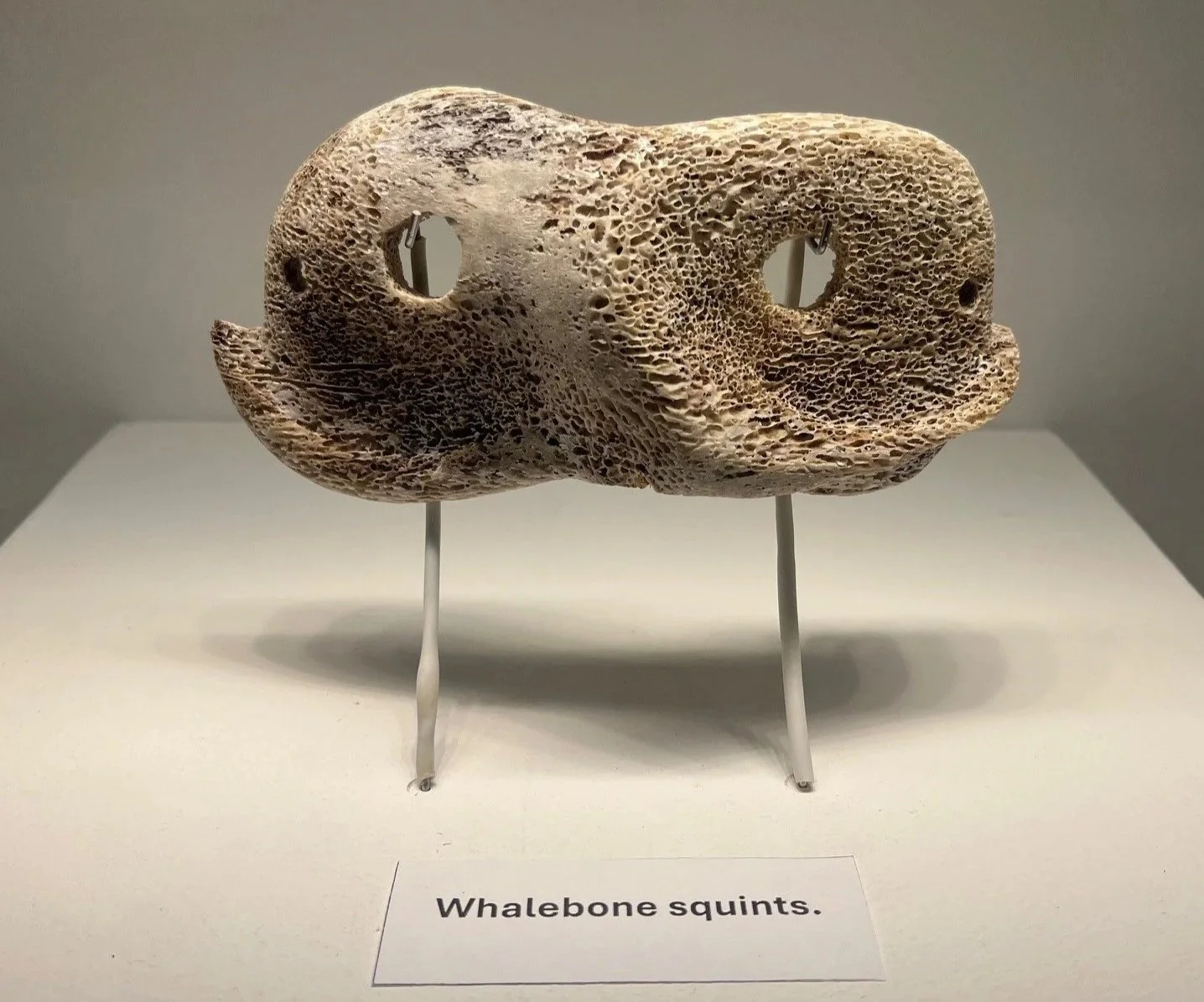
A scattering of more practical items, including a whalebone “squint”, an eye mask designed to protect the wearer from snow blindness, round out the exhibition.
“Aglooka” doesn’t claim that Rae owned or appreciated indigenous art. More than likely he saw it, and knowing his respectful attitude to the peoples he was moving amongst, he probably considered it seriously and appreciatively. This exhibition has been a wonderful opportunity for Orcadians to do the same.
Meanwhile, appreciation of John Rae continues to grow, thanks to writers like Ken McGoogan, broadcasters like Cerys Matthews, and above all the members of the John Rae Society. The preservation and restoration of the Hall of Clestrain remains an ambitious but valuable project. A small and easy to achieve stepping stone would be to rename Franklin Road in Stromness. Rather than commemorating the doomed Sir John Franklin, and his widow, Lady Franklin, who worked so hard to damage John Rae’s reputation, it would be fitting if the street name honoured a remarkable Orcadian. We already have Rae’s Close, so how about Clestrain Road? Or even Aglooka Road!
This diary appeared in The Orcadian on 5th November 2026. A new diary appears weekly. I post them in this blog a few days after each newspaper appearance, with added illustrations, and occasional small corrections or additions.