
Diary of a Shopkeeper, 1st February
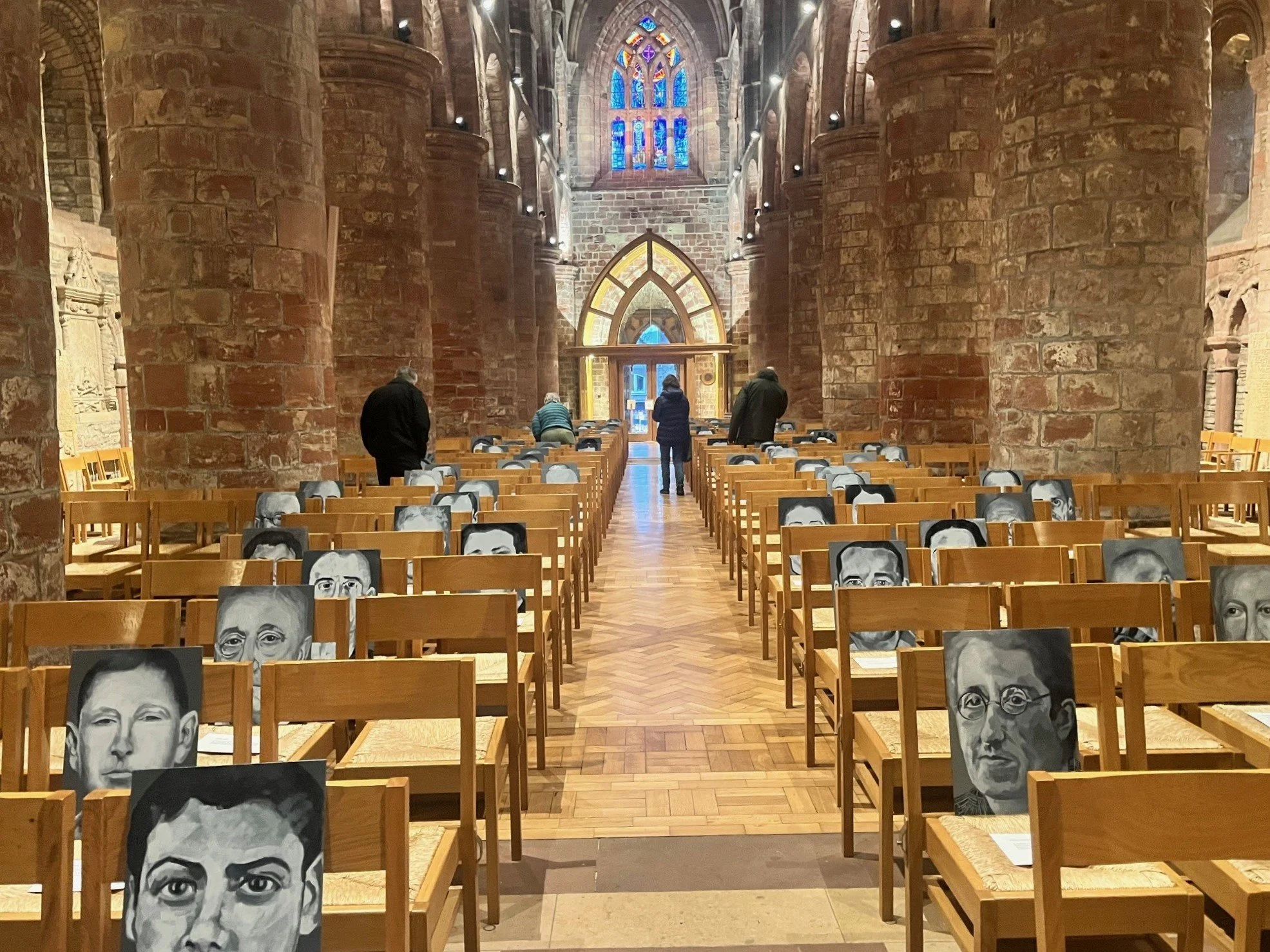
Like everyone who saw it, I was greatly moved by Robert Downes’ exhibition, The Unforgotten: 100 Faces from Auschwitz. It was shown for one day only in St Magnus Cathedral, 27th January, and will live a long time in my memory.
Of course, 27th January isn’t just any day: it’s Holocaust Memorial Day, marking the anniversary of the liberation of Auschwitz-Birkenau by Soviet troops in 1945. Since 2005, Holocaust Memorial Day has been an annual reminder of the six million Jewish men, women and children exterminated by the Nazis, as well as millions more non-Jews murdered with spurious justifications such as political dissension and racial purity. The Memorial Day also reminds us of more recent mass killings, including in Cambodia, Rwanda, Bosnia and Darfur. None of us who have watched or listened to the news in recent months will have to search our memories very hard for similar ongoing crimes against humanity.
Robert Downes’ exhibition was very simple in format: it consisted of 101 black and white portraits, roughly twice life-size, eyes looking directly out towards the viewer. The heads filled each canvas, the images cropped closely. The eyes were enhanced by subtle use of black pigment to render them intensely dark and piercing. Walking down the central aisle of the cathedral, meeting the gaze of these dark eyes, was a deeply unsettling experience. And so it should have been. Each portrait was based on a photograph, taken by the Nazis, of a camp inmate. In front of each painting was a bare record of the life of the individual:
‘BOLESLAW GACZEK. A Polish Catholic Priest born in Sucha on the 23rd November 1881. He was in Auschwitz from the 4th November 1941 and perished in the camp on the 14th November 1941. At least 464 Priests, Seminarians and Monks, as well as 35 Nuns were incarcerated in Auschwitz.’
Some were unbearably painful to read:
‘MADELINE FLOMEBAUM. French Jewish girl born in Paris 9th May 1936. Deported to Auschwitz from Drancy on 24th August 1942. She was murdered in a gas chamber after arrival selection. Aged 6.’
Robert Downes’ portraits and captions would have been powerful wherever they were exhibited, but to arrange them in the central nave of the cathedral was a stroke of genius. Spread out across chairs on either side of the aisle, the 101 faces occupied the same seats that thousands of Orcadians do every year, for services, weddings, funerals and concerts. They looked just like us – of course they did – and they could have been us, had we been unlucky enough to have been born in their place and time.
Despite economic stagnation and social inequality, those of us living in the UK in the 21st century are some of the most fortunate people in history. And if you live in Orkney, you have really drawn the golden ticket. Rarely in human history has there been a place and time when so many are prosperous, part of a stable social structure, and free from the kind of violent persecution that the Nazis rained down on millions of innocent people within living memory.
I’ve been lucky enough over the years to travel widely in four continents. Wherever I’ve gone, I’ve found the local folk friendly, generous and humane – just like we hope to be. And yet every so often a strange madness is whipped up in a people to make them behave, as a group, with cruelty and violence they would normally never countenance as individuals. It’s happening right now in northeastern Kurdistan, also known as Rojava. I write this on the last day of what has been an action week in support of the people of Rojava. The Syrian transitional government (led by former al-Qaeda fighter, Ahmed al-Sharaa) is pushing hard to crush the autonomous democratic government of that area.
And by ‘pushing hard’ I mean through violence and ethic cleansing – i.e. mass murder. In March 2025, in a similar atrocity, around 1,500 Alawites in western Syria were murdered by Syrian forces, based solely on their ethnicity. Their actions are aided by the Turkish government, which has long sought to erase the Kurds, and battalions of former ISIS fighters, released from prison in Syria in recent months and set on their own revengeful course towards another ‘caliphate.’ Western governments turn a blind eye.
Adam and Eve were ejected from their Middle Eastern paradise for eating from the tree of knowledge. We may live in a wet, windy paradise in these islands, but we can’t pretend we don’t know what’s happening in Ukraine, Gaza or Rojava. The words of our poet Edwin Muir, who grew up in prelapsarian Wyre and witnessed the ravages of WW2 across Europe, come to mind: ‘One foot in Eden still, I stand / And look across the other land.’
We stand here in Orkney, but we look across at the rest of the world. And what we see should unsettle us as much as the unflinching gaze of those portraits from Auschwitz.
You can read more about the Holocaust Memorial Day Trust here.
The current conflict has not been covered widely in the UK press, though there are some useful exceptions, including this recent article by Natasha Walter.
I’ve been reading Muir’s poem ‘One Foot in Eden’ for years, but I didn’t know till today that a recording of him reading it was available online.
This diary appeared in The Orcadian on 5th February 2026. A new diary appears weekly. I post them in this blog a few days after each newspaper appearance, with added illustrations, and occasional small corrections or additions.