
Diary of a Shopkeeper, 5th July
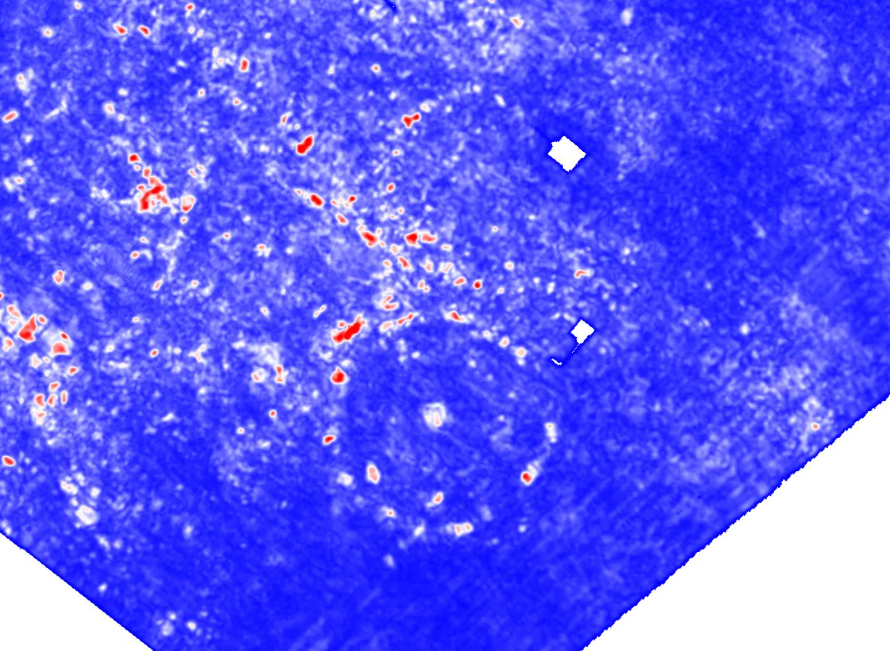
The mysterious circular feature at the Ness of Brodgar, identified during 2025 surveys. (Photo: Time Team.)
Long before Lorraine Kelly fell in love with Orkney, another titan of the entertainment industry took our humble home into his heart. Walt Disney seems to have visited here only once, towards the end of World War Two, while researching his animated film, ‘The Legend of Sleepy Hollow,’ which was released in 1949. ‘Sleepy Hollow’ was based on a short story by Washington Irving, whose father was born at Quholm in Shapinsay.
The Orcadian inspiration behind another famous Irving yarn, ‘Rip Van Winkle,’ is well known. The hapless wanderer tempted into an underground chamber by strange fairy folk promising drink and jollity is prefigured in many an Orkney folk tale. As in those age-old stories, Rip van Winkle emerges after what he thinks is one night, to find the rest of the world has moved on 20 years, and his own children are now grown up, though still living at home, thanks to the shortage of affordable housing in the Catskill Mountains. Another parallel is that the strange small people in Irving’s tale are portrayed playing a game called ninepins. This is widely seen by Disney scholars as a reference to the famous Westray Ninepins dance.
Bing Crosby, who, along with Gracie Fields, George Formby and Taylor Swift was one of the visiting celebrities who entertained troops stationed here during WW2, may have introduced Disney to Washington Irving’s Orkney connection, and the isles themselves. Certainly, it was Bing who went on to narrate ‘Sleep Hollow’ for Walt.
All of this has been public knowledge since Ernest Marwick published his critical essay, ‘St Magnus Does Miracles but Walt Disnae’ in 1967. What is less well known is that Disney’s love for Orkney nearly saw his first theme park established here, rather than Anaheim, California. During his visit, Disney was impressed by the stone circles of Brodgar and Stenness, and by Skara Brae and especially Maes Howe – strangely reminiscent, as it was, of the mound Rip van Winkle disappeared into.
He wrote home to his wife Lillian in 1945: ‘I swear, Lilly Belle, this place could be the biggest resort in the world. It’s clean and green, and the monuments are spectacular – when you stand in that stone circle, you feel you’re in a real magic kingdom. There’s just one or two things lacking, like public toilets. What is it with these crazy Brits? They must have bladders like barrage balloons.’
Disney also felt that the attractions were too far apart, and that they needed to be removed from their original locations and rebuilt much closer together, so families could easily walk between them. He called in his famous team of Imagineers, who started drawing up plans for a green-field site (a field, in other words) near Barnhouse. Their most ambitious plan was to have the Old Man of Hoy dismantled and rebuilt on the banks of Stenness Loch, where it would be renamed the Old Man of Voy. Disney didn’t want to impose his own name on Orkney, and the theme park, gathering together so many of our most famous attractions, was to be known as West Mainlandland.
Given the innovative nature of the project, it’s perhaps not surprising that the Imagineers ran into difficulties, most notably with the Planning Department of the Orkney County Council. Such was the swamp of legislation and red tape the project encountered, that full permission had still not been granted when local government reorganisation came along in 1975, and the old county council was abolished. At that point, the whole planning application was scrapped, and a new one had to be started with the freshly minted Orkney Islands Council
Disney is still awaiting a decision. It’s believed that the main area of dispute is over the movement of the stone circles. Just as rotten windows in conservation areas have to be replaced by identical new ones, even if that means the houses remain damp and cold, so the planning department is insisting that the stones must be moved from Brodgar to Barnhouse using the same methods that our neolithic ancestors used to move them into position 5,000 years ago. Even eminent archaeologists are unsure what those methods were, so it’s impossible to replicate them - leaving the Disney/OIC negotiations stuck in a stalemate.
All of this has been thrown into sharp focus in recent days by the revelation from the archaeologists of Time Team of a mysterious circular feature just under the surface at the Ness of Brodgar. Confirmation won’t be assured until excavations start later this month. But I can exclusively reveal, thanks to extensive research in the Disney Archives in Burbank, California, the true nature of the circular feature, and the two smaller circles abutting it.
It’s a nine-metre-wide representation of the big-eared, smiling face of Mickey Mouse.
The full story of the 2026 excavations at the Ness of Brodgar can be found here, with riveting daily updates.
This diary appeared in The Orcadian on 9th July 2026. A new diary appears weekly. I post them in this blog a few days after each newspaper appearance, with added illustrations, and occasional small corrections or additions.