
Diary of a Shopkeeper, 14th December
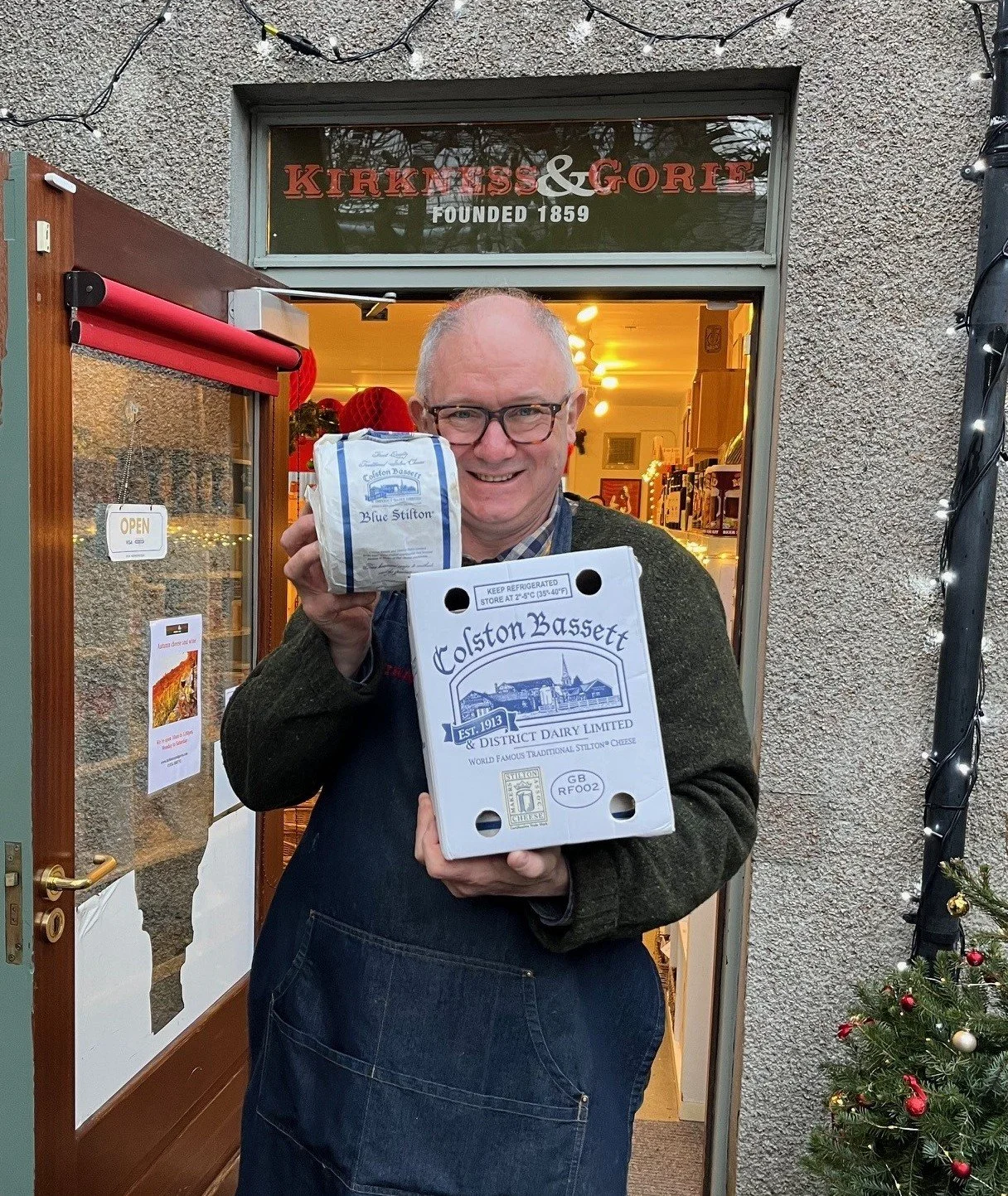
At this time of year, with Christmas Day just a week away, there’s one word on everyone’s mind. It’s a name. And it begins with the letter S. I’m not talking about Santa. It’s Stilton, the king of cheeses and the cheese of kings. Three kings always show up at Christmas, so having some Stilton on hand is a must.
Sales of Stilton soar every December. Some customers don’t want us to cut a wedge of the stuff: they want a whole Baby Stilton for themselves, all 2.2 kilos of it. We love them. We also slightly envy them. Anyone committed enough to organise a feast involving a whole Baby Stilton must be a wonderful person to celebrate Christmas with. What generosity! What festivity! You ho ho, merry Christmas everyone!
Sorry, getting carried away there. I meant to give you some serious history about this seriously good cheese. And here it is:
Just as many wine-regions gained success and fame due to their proximity to ports which allowed easy shipping – think of Bordeaux for Claret, Porto for Port, and Cadiz for Sherry – Stilton rose to prominence because of transport. The village of Stilton in Cambridgeshire was a resting place on the Great North Road, the main route between London and Edinburgh in the days of horse and coach travel. Travellers enjoyed the cheese that was produced in the lush pastures of the fens, and soon local folk realised they could make money by exporting their cheese to London, less that 100 miles south.
What Stilton cheese was like in medieval times is impossible to know, but by the 18th century it was already famous enough to get written about appreciatively. Daniel Defoe, author of Robinson Crusoe (and a pamphlet about Pirate Gow), mentioned it in his book A Tour thro' the Whole Island of Great Britain@
‘We pass'd Stilton, a town famous for cheese, which is call'd our English Parmesan, and is brought to table with the mites or maggots round it, so thick, that they bring a spoon with them for you to eat the mites with, as you do the cheese.’
Stilton as we know it now is nothing like Parmesan, nor does a mouthful include cheese mites. Some famous cheese like Mimolette and aged Cantal draw a significant part of their flavour from the action of mites on their rinds but you never see the microscopic beasties, only their handiwork in the pockmarked rinds, which are too tough to eat anyway.
Stilton does have a noticeably thick and gnarly rind, but that is down largely to ageing while exposed to air, rather than any significant population of parasites. The intensity of its flavour comes from the introduction of Penicillium roqueforti, a harmless culture that is injected into young cheeses by steel needles, and flourishes into that distinctive blue marbling – and a rich, tangy flavour. If you look at the rind of a good Stilton, you’ll see patterns of tiny holes. These are not the work of mites nor maggots. That’s where the steel needles went in.
Gradually the definition of what Stilton was and who could make it became formalised, and laid down in law. Its fame made it a valuable commodity, and upstart cheesemakers from all over England had started to use the name to share its glory. Ironically, the village where it all started became banned from using its own name to describe cheese made there. Stilton cheese can only be made legally in the counties of Leicester, Nottingham and Derby. Stilton the village being in Cambridgeshire, it’s outside the prescribed area of the Protected Designation of Origin.
Imagine if Orkney cheddar couldn’t be made here, but only in Shetland!
For us as consumers, precisely where the cheese is made is less important than how it’s made, and what it tastes like. The strict PDO regulations do ensure consistence of flavour and texture, so they’re not all daft. The ‘paste’ of Stilton (the main body of the cheese) is a strong, dense, creamy mouthful. The unique flavour comes from the blue veins that radiate out from the centre of the cheese (which must always be cylinder shaped.) The blue itself is tangy, sometimes even salty. It’s the combination of the biting blue and the creamy paste that makes Stilton such an enjoyable, complex cheese. Something sweet on the side – sweet chutney, or a glass of Port – adds yet another layer of pleasure.
According to the Stilton Cheesemakers Association, there are currently just six authorised makers entitled to use the name. Our favourite for consistency and depth of flavour is Colston Basset, and we’ve exclusively focused on their Stilton for several years.
Where there are lots of great blue cheeses from across the British Isles, and Europe, there are three that stand out head and shoulders for their unique character and different but delicious flavours. They are Roquefort from southern France, Gorgonzola from northern Italy, and Stilton from England. These are the three kings of blue cheese.
We’ve planned ahead and have excellent stocks of Stilton in our fridges. But if you want to secure some for Christmas, get your order in quick. Otherwise you might be left writing it on your list and hoping the other S, the man in the red suit, has some to spare.
Update a week after writing the above. Cheese mania continues to sweep Orkney, and a good thing too, say all us cheese-mongers, as our fridges are bulging. Or they were…now they are just quite full. We still have Stilton, but not much, so if you want any, pop in or give us a ring ASAP: 01856 888792.
This diary appeared in The Orcadian on 18th December 2025. A new diary appears weekly. I post them in this blog a few days after each newspaper appearance, with added illustrations, and occasional small corrections or additions.