
Diary of a Shopkeeper, 21st December
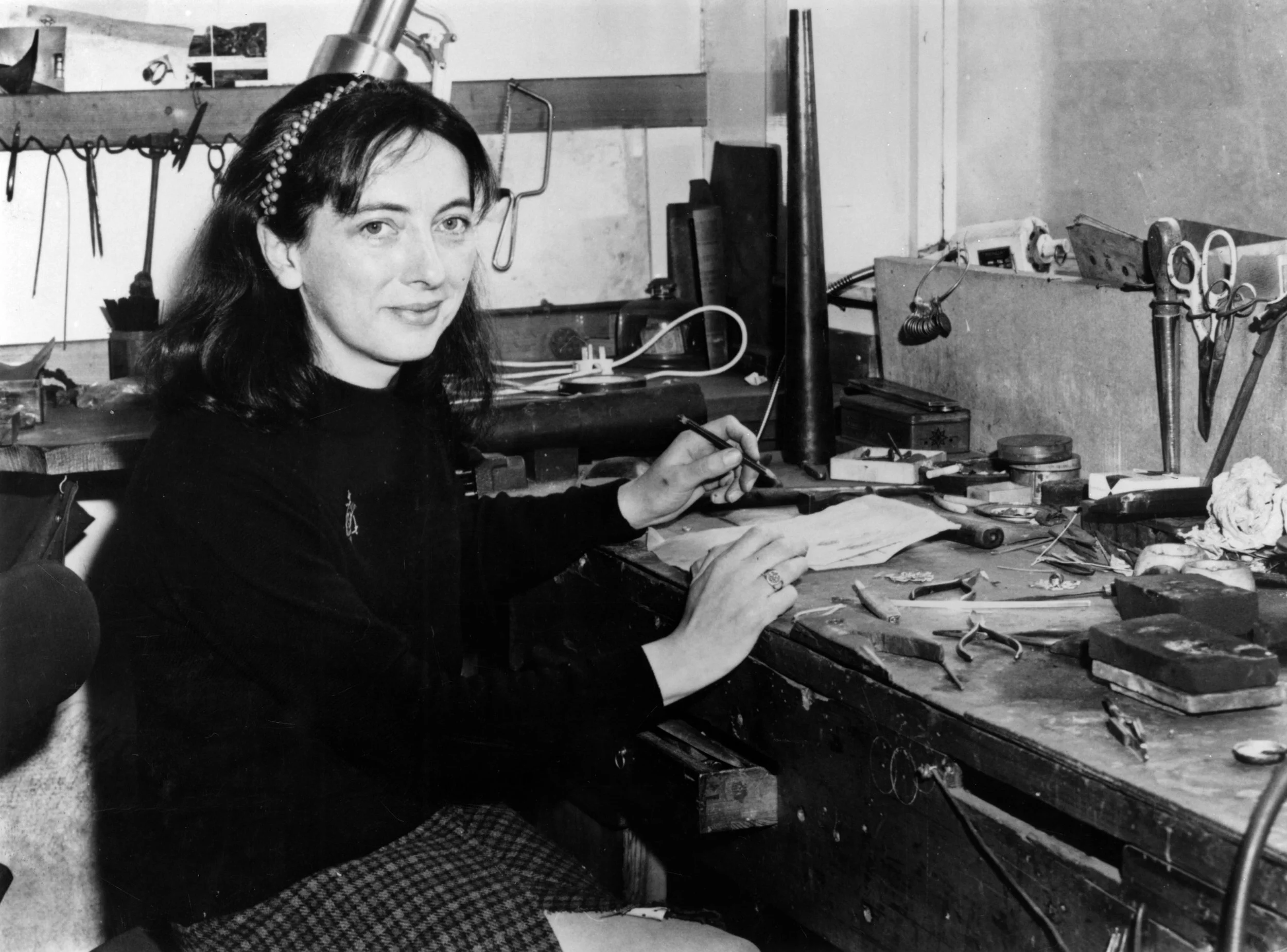
Ola at her jewellery bench, 1960s
This is the 300th Diary of a Shopkeeper, which seems like an excellent opportunity to look back. What I’m excited to look back on is not all the cheese and chat across the counter, nor even the year that is rushing towards its close. Rather, I’d like to look back at 65 years of a unique Orkney industry, and a fantastic exhibition celebrating it that ends at the Orkney Museum on Christmas Eve.
From Broch to Brooches: Tracing Orkney’s Timeless Craft, opened at the museum in mid-November. I’ve been to see it several times, and if you haven’t yet, I strongly recommend it. The craft of the title is jewellery, and the exhibition opens with a small selection of pieces from the museum’s permanent collection. In the Neolithic, jewellery was made from bone, shells or – as in the necklace found in Westray shown here – cetacean teeth. By the Bronze Age, metal – including gold, as used in the penannular ring from Lamb Holm on display – was the material of prestige. Our Norse forebears were skilled at crafting intricate, finely-detailed jewellery. The 9th century oval brooch shown here would not look out of place on a 21st century lapel.
There are not many parts of the material culture of twelve hundred years ago that still look contemporary. If you walked into Kirkness & Gorie wearing Viking clothes or Pictish shoes, we would notice their strangeness immediately (though we’d still sell you some Stilton and Malbec.) Why jewellery is different can be laid at the feet of one woman, Ola Tait, who, under her maiden name of Ola Gorie, kickstarted not just the modern jewellery industry, but a whole new way of looking at our history.
The exhibition begins with a section devoted to Ola. When she graduated from Gray’s School of Art in 1959, she was not only the first student to gain a diploma in jewellery design, she was also the first person to start making jewellery in Orkney since medieval times. Ola’s commercial success, first in a small way selling purely to local shops, then nationally, and eventually internationally, led others to realise there was a market for good quality Orkney jewellery. Craft could be a profession, not just a winter’s night pastime.
Soon other jewellery companies sprung up in Ola’s wake: Ortak, Sheila Fleet, Aurora… These are some of the larger companies with the furthest reach, but the exhibition also highlights the remarkable array of smaller producers who bring so much talent and so many new ideas to the scene: Karen Duncan, Celina Rupp, Alison Moore, Marion Miller, Zoe Davidson and Fluke Jewellery. And those are just the jewellers featured here, all members of Creative Orkney. There are more doing good work who aren’t members of that group, and still more who have made their mark in the past and moved on.
Over the years, hundreds and hundreds of local folk have been proud to be involved in designing, making and selling Orkney jewellery. The evolution from one young art student to a key Orkney industry is beautifully illustrated in the exhibits in Broch to Brooches. Not just jewellery, but early brochures and leaflets, newspaper clippings, staff photos. As a piece of social history it could hardly be bettered.
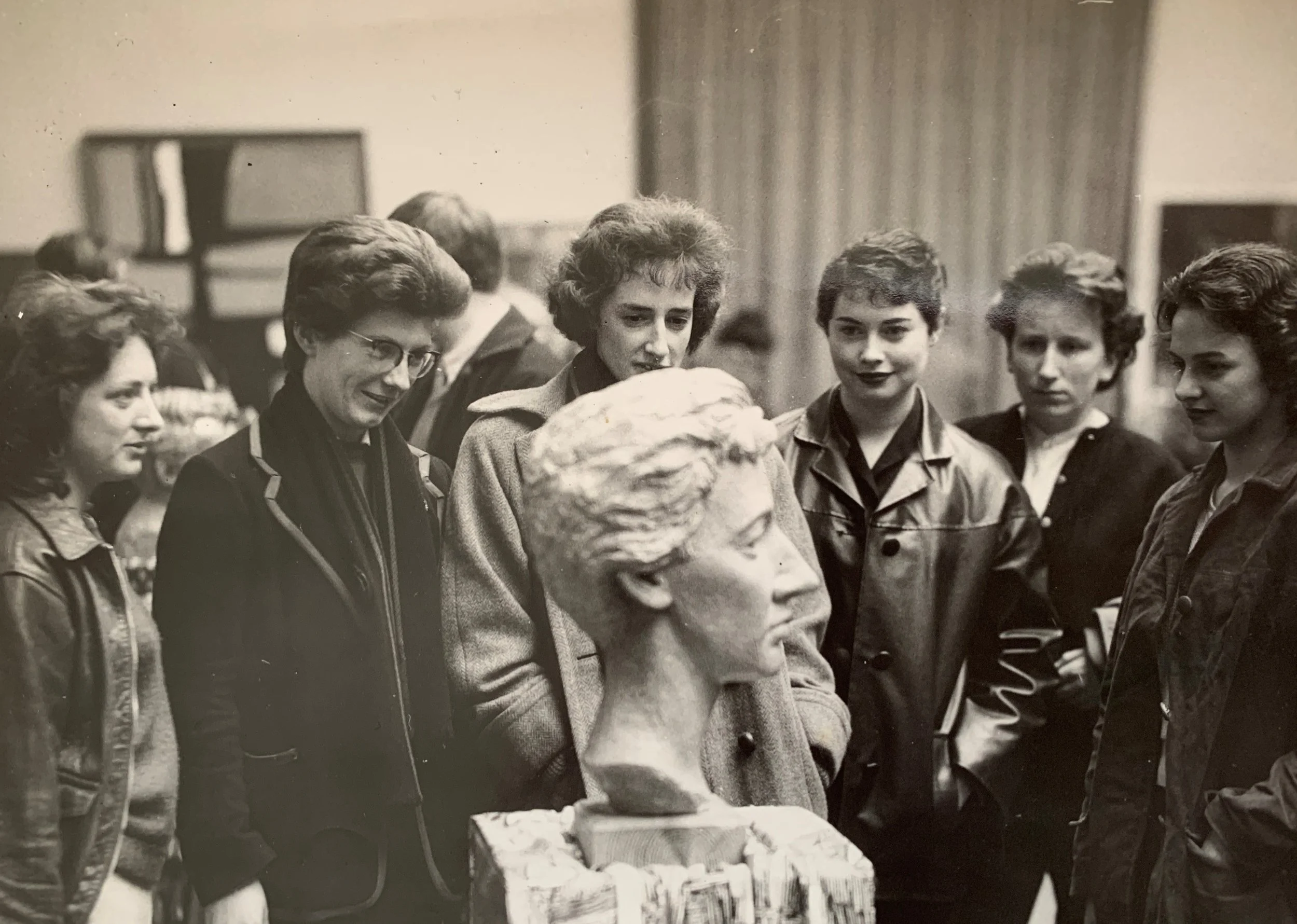
Art school days, c1958: Ola Gorie far left, Sylvia Wishart second right
What strikes me even more, is the extent to which Ola – and others who followed – looked at Orkney’s history and interpreted it in ways that had never been done before. Ola was part of that remarkable post-war generation of students who went away to study and came back with new skills, new ideas, and new ambitions. Sylvia Wishart (who shared a flat with Ola at art school) was going to paint Orkney like it had never been painted before. George Mackay Brown – a friend of both Sylvia and Ola – was going to tell the stories of Orkney’s past and present with a unique new voice.
And Ola started to interpret hitherto obscure images from Orkney’s history – crosses from St Magnus, Pictish symbols, Viking carvings of runes and dragons – and turn them into exquisite 20th century craft. She saw those pieces of history as no one had seen them before. She made them new. And they still look new today. Of course, I am biased. Ola is my mother-in-law, and I am perpetually amazed by the dynamism and creativity she and Arnie maintained over decades, and the inspiration their example still provides.
You don’t have to take my word for it. Rush to the museum before the exhibition closes and see for yourself. Congratulations to the Exhibitions Officer, Mark Scadding, to Kirsteen Stewart of Creative Orkney, to the volunteers who helped set up the show, and to all the exhibitors. Their achievement is dazzling.
This diary appeared in The Orcadian on 23rd December 2025 (published early due to Thursday being Christmas Day.) A new diary appears weekly. I post them in this blog a few days after each newspaper appearance, with added illustrations, and occasional small corrections or additions.