
Diary of a Shopkeeper 4th October
The sight of the South Mainland Up Helly Aa jarl squad parading the streets of Stromness warmed the cockles of the coldest hearts, especially as they were carrying flaming torches while they marched, and set a viking galley ablaze when they reached the Ness slip. The visitors received rousing support and seemed to be enjoying themselves enormously. Oh aye, Shetland folk know how to enjoy themselves!
Despite so much shared history, the differences between here and there can be considerable. Whenever I travel north, which must have been 20 times over the past 40 years, I feel it as soon as I step off the plane or the ferry. Shetland is our closest foreign country. No doubt it comes down to a mixture of factors, but one that always strikes me is the difference in language. This was reinforced during the recent Orkney Science Festival, when, on successive evenings, there were presentations on, ‘What’s the Future of the Orkney Dialect?’ and, ‘A Language Once Again.’
The first event was an interesting, well-mannered survey by Dr Tom Rendall and Dr Sarah Jane Gibbon of some aspects of the way Orkney folk speak and write now. Although the word ‘language’ was used once or twice, along with a single ‘mither tongue’, the most common descriptor was ‘dialect.’ By contrast, the main Shetland speaker, Professor Viveka Vellupillai, unashamedly used the world ‘language’ throughout. And there was no question mark at the end of her lecture’s title. ‘A Language Once Again’ is a bold declaration, not a point up for discussion.
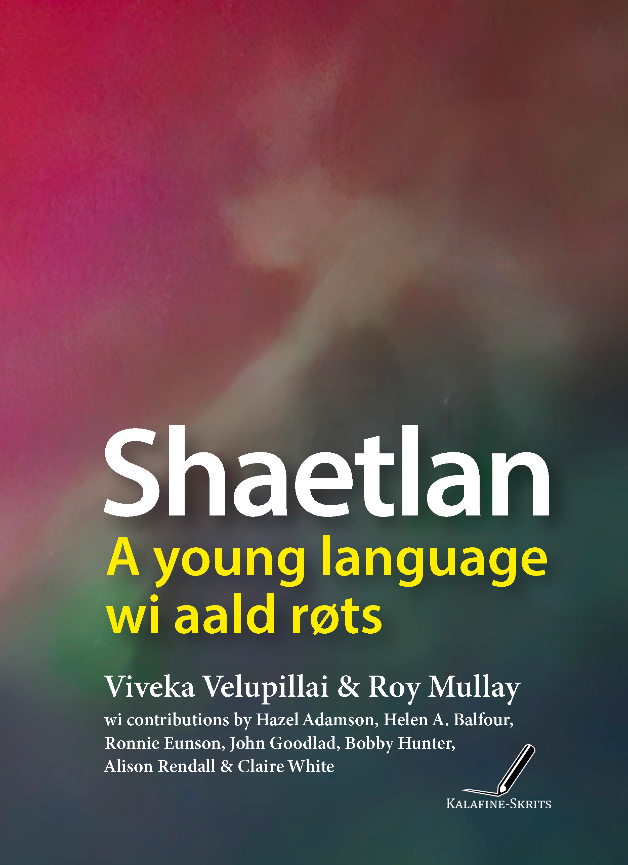
Professor Vellupillai based her talk on something that Orkney has never benefitted from: a modern, full-length, professional linguistic analysis of the language spoken and written in the islands. Called Shaetlan: a young language wi aald røts, the book was written by Velupillai and Roy Mullay, and published last year. Here we’ve had invaluable dictionaries from Gregor Lamb and Margaret Flaws, though those are more than 25 years old. Hugh Marwick’s scholarly Orkney Norn is approaching its hundredth anniversary. For grammar, we have to look for the long out of print The Norn Language of Orkney and Shetland by Michael Barnes. There are various online sites touching on Orkney language, though it’s hard to be sure how accurate and up to date they are. The best and most trustworthy online resource used to be orkneydictionary.scot. but sadly that’s no longer live. When you add all Orkney’s current resources together, the collation pales into insignificance compared to Velupillai and Mullay’s Shaetlan.
It was emphasised during the Science Festival event that the book is not just a description of what used to be, nor a lament for loss of vocabulary or change of accent. Rather, it’s a serious and thorough analysis of how Shetlanders currently speak and write, a history lesson on how that came about, and a survey of where that places the Shetland ‘midder tongue’ in a context of both historic language development and current varieties around the world. People used to joke that, ‘A language is a dialect with a navy,’ but there’s none of that casual avoidance of a difficult topic from Velupillai and Mullay. Their conclusions are clear: ‘Shaetlan is, by defineetion a Contact Language, seein as it cam aboot trowe a specific contact situation – in dis caess da lang draan contact atween da Norn speakin oreeginal settlers of Shetland and da Lowland-Scots-speakin new settlers o Shaetlan.’ Ah yes, they put their money where their mouth is, and write the book in Shaetlan, amounting to the longest piece of prose I’ve ever seen in the language. Translations into Standard English are also provided, though I don’t think anyone from Orkney would have a problem reading the original.
The book is also a polemic, you might say a political manifesto, insisting on greater recognition for Shetland’s language and culture. If politics and language seem like two separate parts of life, Orkney’s own Dr Ragnhild Ljosland was present at the Science Festival event to remind us of the history of the two official Norwegian languages, Nynorsk and Bokmål, and their importance to Norway’s developing sense of its own identity in the years after it gained independence. As well as Raggi, Professor Velupillai was assisted by Barry Nisbet from Yell, a musician and student of the famous ‘Hildina’ ballad, the longest piece of writing to survive in one of the two languages that fed into Shaetlan, Norn. Barry persuaded almost the whole audience in the Orkney Theatre to come down onto the small apron in front of the stage, hold hands, and shuffle around in a chain dance, stamping their feet and singing along with him on the chorus of ‘Hildina.’ It was probably the first time this song had been sung and danced in Kirkwall for three hundred years. I don’t expect it will be taken up by the young folk on the floor of Rapture any time soon, but nonetheless it was a moment that felt significant as well as enjoyable.
Following in Shetland’s footsteps, Orcadians seem to appreciate a bit of viking fancy-dress and galley-burning more than ever. Maybe we can also learn from our friends in the north when it comes to valuing the language of our islands.
If you don’t want to splash out on this big book straight away, have a look at the website the authors are involved with, https://www.iheardee.com/. It covers the main points of the book, adds supplementary material, and provides links for buying or downloading the book.
This diary appeared in The Orcadian on 8th October 2026. A new diary appears weekly. I post them in this blog a few days after each newspaper appearance, with added illustrations, and occasional small corrections or additions.