
Diary of a Shopkeeper, 27th September
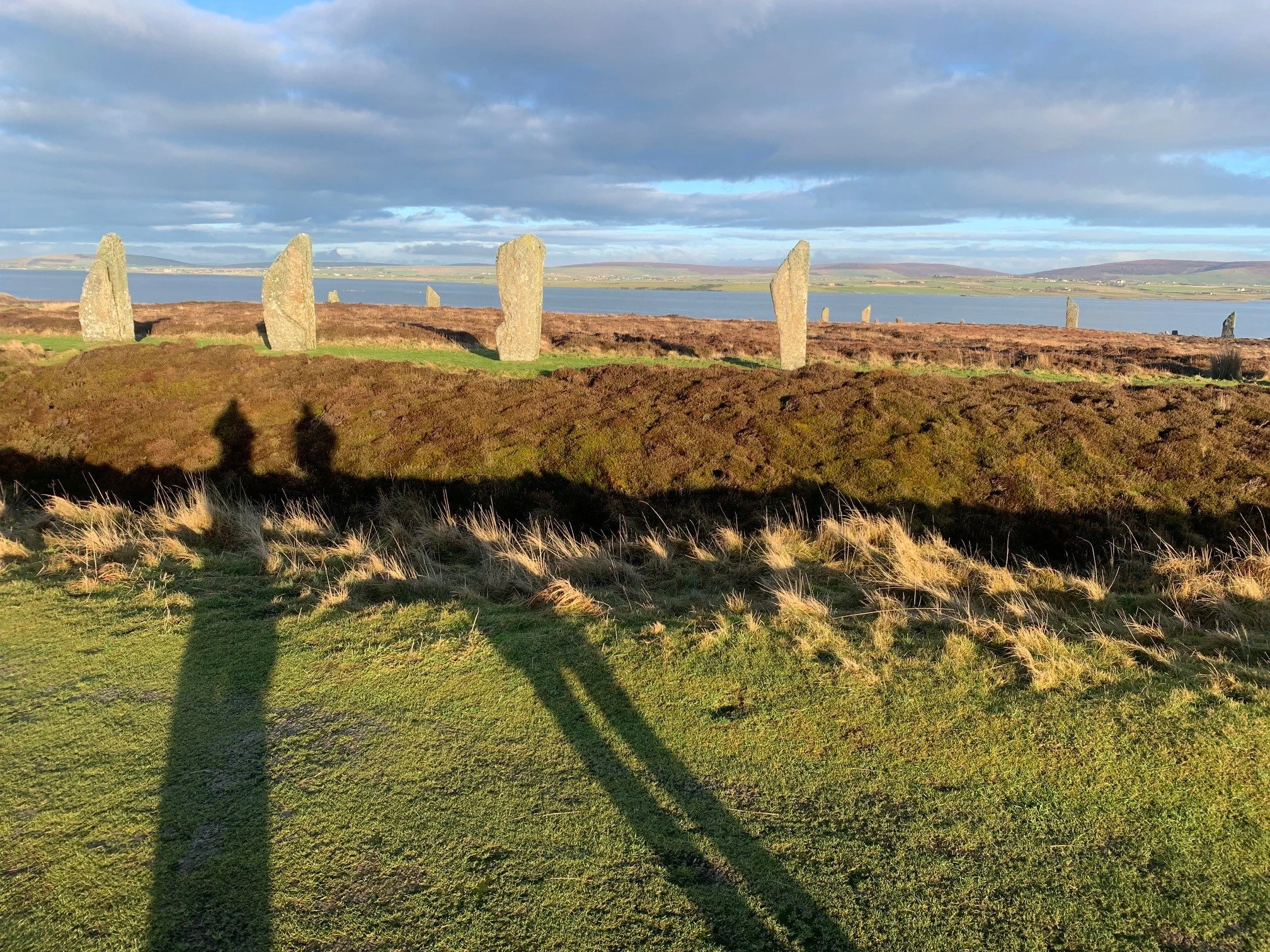
The shadow of the present hangs over the past.
When I was a boy, I used to love reading science fiction comics. As well as the tales of spacemen battling aliens in faraway galaxies, there were often speculative essays about what life would be like in the distant future, say the year 2000. These pieces were called things like “Cities of Tomorrow” and were illustrated with drawings of gleaming skyscrapers with jetcars swooping between them, moving pavements packed with commuters in one-piece metallic suits, and glass domes on the 73rd floor which swung open to let your personal flying saucer out.
I was reminded of these visions when I attended one of the drop-in sessions the council organised to present various options for the development of the Heart of Neolithic Orkney. There was a healthy turnout of local folk at Stenness School on Tuesday to see the plans and talk to OIC staff and visiting consultants. As well there might be! Although everyone in the county has visited the great monuments at one time or another, and folk from all the airts zoom through Stenness on the main Kirkwall to Stromness road, it’s us Stenness residents who actually live here.
We walk, cycle and drive here daily. We work and socialise here. We use the community school for a hundred different purposes. We get petrol and groceries from the shop, cones from the ice-cream parlour, and bar suppers from the hotel. For Stenness folk, the Heart of Neolithic Orkney isn’t a UNESCO World Heritage Centre: it’s home. Well, it’s both, which is the problem.
If you look at a map of Stonehenge, you’ll find that it lies in a vast expanse of rolling downland: 2,100 acres of uninhabited and uncultivated grassland, cared for by the National Trust. The nearest village is Rollestone, two miles west by road, and the nearest town is Amesbury, five miles southeast. It’s a very different landscape to ours, where working farms surround our monuments on every side, houses are scattered every hundred yards or so, and the Stones of Stenness are less than a mile from the village.
Both UNESCO and Historic Environment Scotland have preserving the monuments and the landscape around them as their top priority, and they are zealous in doing so. None of us who live and work here would wish any different. It wasn’t always like that. In 1814, the tenant farmer at Barnhouse, John Mackay, infamously blew up the Odin Stone, and fully or partially destroyed two more of the Stones of Stenness. His grudge? Too many visitors were walking over his land to see the stones. We don’t have to go back two centuries for examples of such vandalism. Within living memory another standing stone here was cowped and buried by a Stenness farmer who found it inconvenient.
Such blatant acts of destruction are surely a thing of the past. Partly because all of us who live here are prouder than ever of these ancient monuments, and partly because those official bodies like HES are fiercely protective of them. Our pride in our heritage, and the protection, interpretation and publicity the monuments receive, have, ironically, created a different threat of destruction. The numbers of visitors to the sites have soared: estimates vary from 100,000 to 175,000 visitors per year. Whichever of those is accurate, the worry is the same: erosion of paths, damage to road infrastructure through increasing traffic, anti-social behaviour (often toilet-related!) and dangerous mixing of pedestrians and vehicles on busy roads.
Tourism is one of the two or three most important industries in the county. Hundreds of people depend on it for thir livelihood, either directly or indirectly: for every gift shop or hotel that benefits first-hand from visitor spending, there are craftspeople, food and drink producers, and farmers, whose products pass down the distribution chain and into tourist shopping bags. In turn, much needed income passes up that chain and into every corner of the county.
We can’t do without tourism, but we do have to manage it. The presentation I saw on Tuesday made a brave attempt to with specific relation to the Heart of Neolithic Orkney. Some of the ideas seemed sensible (e.g. a 30mph speed limit through Stenness village, with its houses, school and shop) while others seemed ludicrous (e.g. making the main Kirkwall to Stromness road single file with passing places from the Brodgar crossroads to the hotel.)
There’s not space here to debate the rights and wrongs of the dozens of ideas that were presented. I can only make a general point. The comic book Cities of Tomorrow of my childhood both over- and under-estimated the changes that would occur in the past half century. They over-estimated the number of flying saucers and jetcars that would be zooming around. And they underestimated the extent to which farmers would still be ploughing fields, bin-lorries would still be collecting rubbish, kids would still be getting muddy in playgrounds and football parks. I fear something similar characterises the heritage site plans. They over-estimate the effectiveness of the proposed plans, and under-estimate the effect on the local population, who have the blessing and curse of trying to live their lives in the shadows of our ancestors’ monuments.
Clearly something has to be done to manage visitor numbers and preserve our heritage, but I’m not convinced the current proposals get us there. Back to the future!
This diary appeared in The Orcadian on 1st October 2026. A new diary appears weekly. I post them in this blog a few days after each newspaper appearance, with added illustrations, and occasional small corrections or additions.