
Diary of a Shopkeeper, 13th September
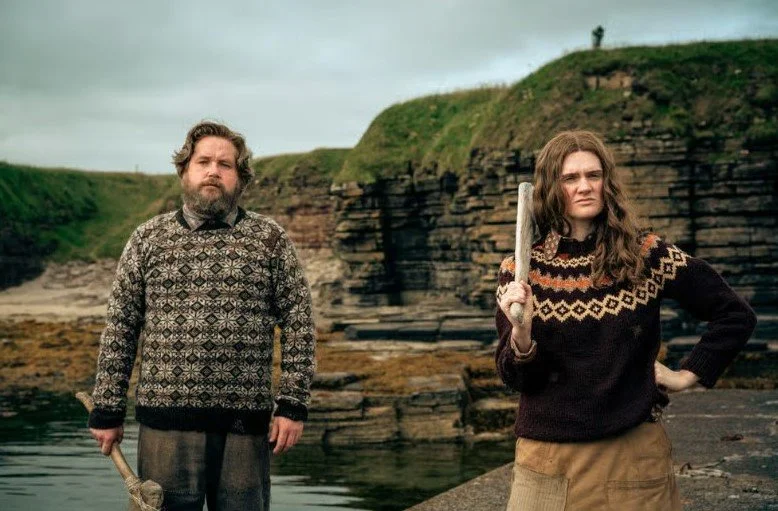
They must have popped across to The Longship for their jumpers.
The Aaks are the inhabitants of Westray, just as the Crabs live in Harray and the Limpets in Stronsay. So you might well call Westray Aak Island. But now, thanks to film director Louis Paxton, Aak Island has a different location, somewhere in the Pentland Firth. It’s definitely not Westray, and it’s not quite Swona, not quite Stroma. In fact it’s not quite a real island at all. It’s a mythical place, a dream place, a magical place. Not in the way that all of Orkney is magical is you’re on holiday and you’ve drunk too much Dark Island and breathed too much balmy, briny air. It’s magical in the way that old tales retold by Tom Muir or Walter Traill Dennison are magical. Which means it’s a place rooted in reality but where fabulous, fantastic and supernatural happenings are as accepted as everyday mundanities. The title of Edwin Muir’s first autobiography sums up this way of seeing the world: ‘The Story and the Fable.’
Paxton’s film, The Incomer, has been a hot topic of conversation in the shop this week. ‘Have you seen it…what did you think of it…wasn’t it brilliant…’ I saw it at the Picky on Tuesday night, and yes, it was brilliant. And weird, weirdly brilliant, brilliantly weird. That’s a rarity in the cinema. The costs of making even a so-called small budget film are so high, and so much depends on achieving sufficient success to claw back the initial investment, that risk is avoided at all costs. Extensions of successful franchises are low risk. Remakes of hit films or TV shows from past decades are low risk. Above all, stories that rehash familiar narrative patterns – boy meets girl, boy loses girl, boy gets girl back, or, hero on a mission, disaster threatens hero, hero finally triumphs – are low risk. So three cheers for Louis Paxton and his brilliantly weird film that avoids the cliched narrative arcs. I won’t give away the whole story here, in the hope that you might be encouraged to go and see it yourself, but the scenario is easily summarised.
A 30-something brother and sister live on the otherwise uninhabited Auk Isle. The council on the nearest bit of the mainland decides they don’t have the right to be there and sends staff to remove them – by force if necessary. The siblings, schooled by their long-since deceased father to distrust and fight off anyone from the mainland, wage a guerilla campaign to repel the incomers and preserve their isolation.
A lot of the humour in the film – and it is very funny – comes from the culture clash between the zealous council pencil-pushers and the eccentric, semi-feral siblings. At times this reminded me of The Wicker Man. The ingenious tactics and tricks the islanders use to see off the incomers evoked memories of Home Alone. The crucial role the island’s gulls play in the dramatic climax was reminiscent of The Birds, and Hitchcock does get a namecheck – to the bemusement of the siblings, who have never heard of him. There are elements of folk horror – skeletons on sticks dotted around the cliff edges – that seem to echo Iain Banks’ classic macabre novel of life on a small Scottish island, The Wasp Factory. And there are many references to motifs from folk tales, most significantly the old Orkney one of the Finfolk. A suitably sinister finman tries repeatedly to lure Isla to come under the sea with him. She is tempted by his blandishments, in a way that makes the viewer question just what really impelled her father to ‘give himself to the sea’ many years before. The mythic interpretation is of ritual self-sacrifice to preserve the tribe of Auk Isle. The psychological interpretation suggests mental health issues. Thus, as the film reaches peak weirdness, with the siblings dressed as giant birds like figures out of Charles Fréger's Wilder Mann photos to scare off the incomers, the real humanity and psychological depth of the story come through.
It’s a remarkable achievement to switch focus from the tough reality of island life to wild fantasy, to animated folk tales, to genuine insights into the pull of the mainland when you’re a young person from a small island, all while moving quickly from one improbable situation or daft joke to another. Apart from a shot of the northern lights, the usual clichés of island life on screen are avoided. Instead we get a story rich in invention, originality and emotion. Louis Paxton, the writer and director, has strong Orkney connections, as does first assistant director Ewan Stewart. Bravo to both of them, and to the whole cast and crew of this brilliantly weird film.
‘Aaks!’
This diary appeared in The Orcadian on 17th September 2026. A new diary appears weekly. I post them in this blog a few days after each newspaper appearance, with added illustrations, and occasional small corrections or additions.