
Diary of a Shopkeeper, 17th May

High heaven save us from the symbolists, from the abstracters! Give us back the earth and the flesh and the lovely currents that flow in and between them!
Neil Gunn, The Serpent (p87)
A new publisher, North House Press of Dalreavoch, Sutherland, is celebrating the centenary of Neil Gunn’s debut novel by reissuing three of his books. Last week I wrote about The Grey Coast, which was positively reviewed, but sold fewer than 700 copies in the year following publication. Gunn kept his day job at Glen Mhor distillery.
Subsequent novels were more popular. Morning Tide, Highland River and The Silver Darlings won praise from critics and sold in their thousands. They were less bleak and claustrophobic than The Grey Coast. They didn’t ignore the challenges of growing up, making a living, and finding love in Caithness crofting and fishing communities. But they celebrated triumph over adversity, and started to develop Gunn’s mature vision of ecstatic unity with nature.
By 1943, Gunn had settled with his wife Daisy in a comfortable house near Strathpeffer, and was established as a prolific professional writer. The novel he published that year, The Serpent, is generally considered one of his best. North House Press have done readers a great service by bringing it back into print.
The story takes place in two timeframes. The ‘present’ is one day in the late-1930s. Tom, an elderly resident of a village very like Lybster or Helmsdale, climbs the hills behind his home. He looks back at the place he has spent all his life, and also looks back over his memories. In particular he looks back to about 1890, when, as a young man, he went away to Glasgow. He returns to his village with new skills, fresh enthusiasms – including for that new-fangled invention, the bicycle – and radical ideas, including atheism and socialism. In a conservative, kirk-dominated community, these ideas go off like a bomb exploding. The first victim is Tom’s father, who dies of apoplexy after hearing his son express what, to him, is a terrible blasphemy.
Tom himself is the second victim, for his character is damned forever after as the man who killed his own father with dangerous ideas and wild words.
Before long there’s another victim. On his return to the village, Tom finds himself powerfully attracted to a local girl, Janet. She reciprocates his romantic interest, and they meet in secret for many months (though what they do when they meet is largely left undescribed.) Rather like Maggie and Ivor, the would-be lovers in The Grey Coast, young Tom is painfully inarticulate when it comes to expressing his emotions. This surely contributes to the withering of Janet’s affection for him. When he finally outlines his plans for renting an old croft they can both live in, and his ideas for opening a small shop, it’s too late. She has transferred her affections to Donald, the slick son of the manse. Tom is aghast at what he sees as Janet’s betrayal, and his emotions spiral into mania when he discovers Janet is pregnant. The unco-guid minister’s son has seduced and abandoned her. In a scene more reminiscent of a Victorian melodrama than a novel from the height of literary Modernism, Janet loses her life.
If Janet is a victim, who is the perpetrator? Is it her mother, a violent alcoholic? Is it Donald, who gets her pregnant then runs away to Canada? Is it Tom, who can’t develop sufficient maturity to express his emotions to her, barely even to talk to her except in secret, out at the moorside under cover of darkness? Or is the violence done by society itself? While ‘present day’ Tom climbs further into the hills, he meets a shepherd and they discuss politics, economics and the changes in the strath since their younger days.
‘What a swarm of life was there!’ says Tom. ‘The harvest field – and the harvest home. A merry crowd they were, and each as full of character as an egg of meat.’
‘What an extraordinary change there has been in a lifetime,’ replies the shepherd.
‘Machinery,’ says Tom. ‘First the reaping hook, then the scythe, and now the binder.’
The mechanisation of agriculture might well crystalise the kind of ‘progress’ that Tom, in later life, worries about – just as George Mackay Brown did – thinking it destroys traditional values and ways of life. But so might the bicycles that he introduced to the village, which were followed by buses, and now by cars – for which Tom’s shop sells petrol. And so might the radical ideas of his youth, which he seeded in the minds of his yamils.
Gunn cleverly positions Tom, not just as ‘The Philosopher’ (one of his teu-names) but also as ‘The Serpent’ (another nickname.) This recalls the biblical devil in the form of a snake, of course: ‘the serpent was more subtil than any beast of the field which the Lord God had made.’ But it also evokes a more secular Highland archetype, as Tom recognises himself: ‘The old Gaelic image of eternity was the wheel made by the serpent when it put its tail in its mouth.’ Or the wheel of a bicycle.
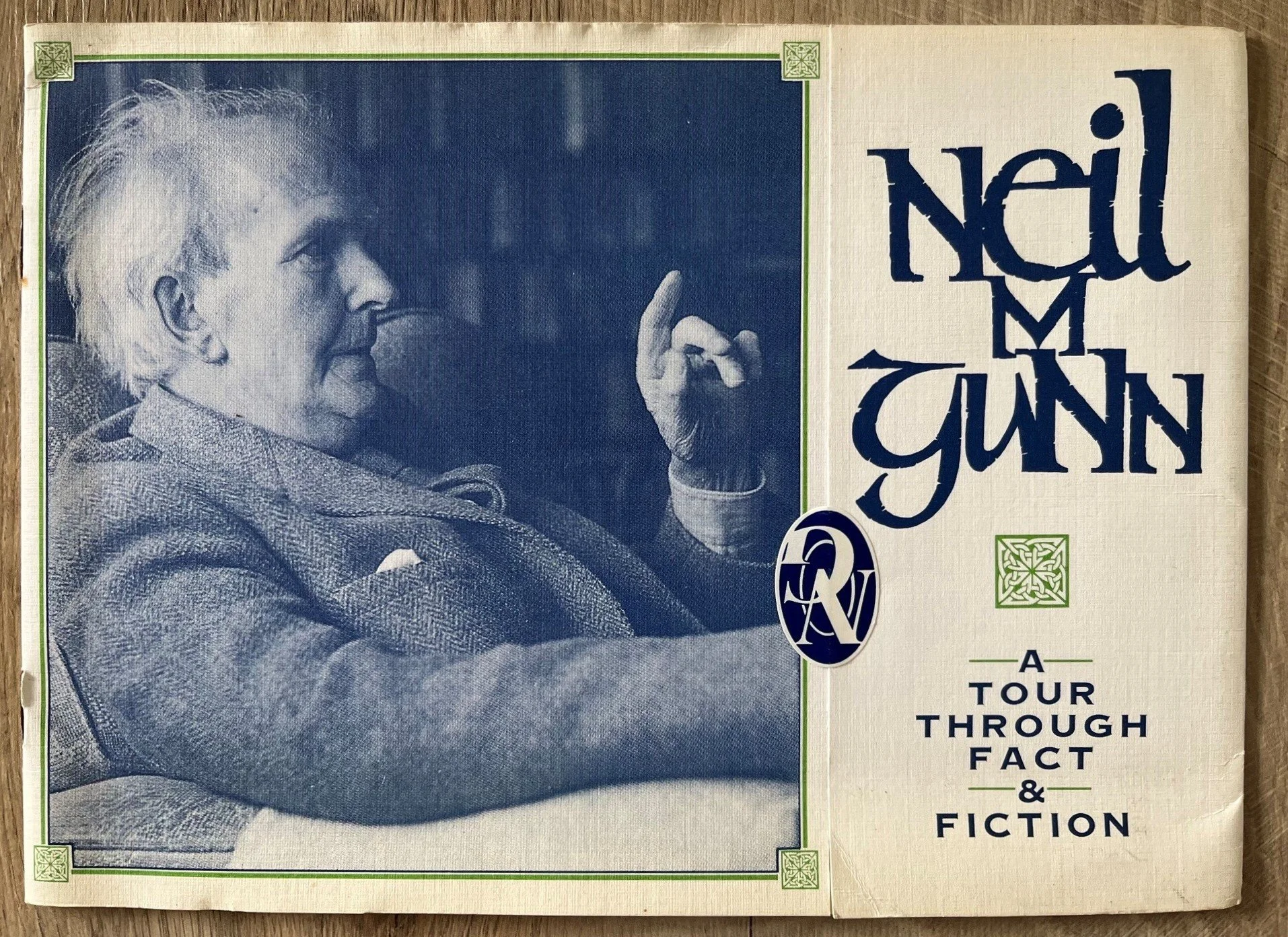
Cover of booklet produced by Caithness Tourist Board, 1973.
The Serpent has none of the purple prose that mars The Grey Coast. It moves fluidly, often lyrically. The first two-thirds of the book are highly accomplished: rarely has there been such a finely grained yet powerful account of the clash between fiery youthful radicalism and the stern repression of a conservative community. Unfortunately, the chapters relating the explosive climax that Tom triggers are melodramatic, devaluing the carefully observed realism of the pages that lead up to them.
The ending moves beyond melodrama into a form of storytelling through symbolism that is brave and bold, if frayed with loose ends. Unlike the serpent of the Gaelic myth, The Serpent does not complete a neat circle with its tail in its mouth.
You can read more about North House Press here, and buy all three Gunn reprints at a special reduced price: great value, for three beautifully produced hardbacks.
This diary appeared in The Orcadian on 21st May 2026.. A new diary appears weekly. I post them in this blog a few days after each newspaper appearance, with added illustrations, and occasional small corrections or additions.